
You've just paid for brand-new tires, so seeing the technician add wheel weights can raise a question. Shouldn't new tires already be balanced? The balancing job measures the complete assembly after the tire is mounted, including the wheel, valve, and any fitted sensor. Each of those contributes to how it rotates.
Small differences in mass are normal, even in new components. Wheel weights compensate for the imbalance measured in that finished assembly. Their amount and position may look different from wheel to wheel, and that's expected. The goal is smooth rotation, particularly when road speed makes small imbalances easier to feel.
New Tires Still Have Small Mass Variations
Manufacturing produces a tire within design tolerances, but it doesn't place exactly the same mass at every point around its circumference. Reinforcing materials, rubber, and construction details create small differences. Those differences become more noticeable when the assembly rotates rapidly rather than sitting still in the service bay.
The wheel also has its own mass distribution. New components aren't perfectly uniform, and an older wheel can introduce additional variations. Balancing measures how they work together after mounting. Adding weights is a normal part of that process rather than proof that the new tire is defective.
Wheel Balancing Measures The Mounted Assembly
A balancer spins the mounted tire and wheel and calculates where correction is needed. Depending on the imbalance, weights may be placed in different planes on the wheel. Their amount and position are chosen from the measurement, rather than added by eye until the wheel appears evenly balanced.
Accurate centering on the equipment is essential. If the assembly is mounted incorrectly for the test, the resulting correction can be misleading. The shop should use the appropriate adapters and confirm the finished result. Repeating the measurement helps establish that the work addressed the imbalance rather than a setup error.
Wheel Weights Correct Uneven Rotating Mass
A heavier area creates an uneven rotating force as the wheel spins. Correctly placed weights counter that mass imbalance and help the assembly rotate more smoothly. Select adhesive or clip-on weights based on wheel design and available mounting locations, including clearance for brake components.
The weights don't have to look identical on every wheel. Each assembly has its own measured correction. Two new tires of the same model can need different amounts, and the final placement may be hidden behind the spokes. Visual symmetry isn't the goal; a suitable measured balance is.
Tire Imbalance Can Become Noticeable At Higher Speeds
An imbalance may feel like vibration through the steering wheel, seat, or vehicle body, depending on where it occurs. It can become more noticeable within a particular speed range. That doesn't mean every highway vibration comes from balancing, because tire damage, wheel problems, and worn components can create similar sensations.
Useful details for the shop include:
- The speed range where the vibration starts and fades.
- Whether it began immediately after tire installation.
- Whether you feel it mainly through the steering wheel or the seat.
- Whether it changes during acceleration or braking.
Describe those conditions accurately rather than repeatedly driving faster to make the vibration stronger.
Road Force Variation Is Different From Tire Imbalance
A tire can be balanced for mass and still produce a varying force as it rolls under load. Differences in stiffness, shape, wheel runout, or mounting can contribute. A suitable load-based test can help identify concerns that an ordinary spin balance alone doesn't fully explain.
Depending on the findings, the shop may reposition the tire on the wheel, correct seating, or assess a damaged component. More weights don't fix every shape or uniformity problem. Ask what the measurements show if vibration remains after balancing, rather than assume the only answer is another weight adjustment.
Tire Balancing And Wheel Alignment Correct Different Conditions
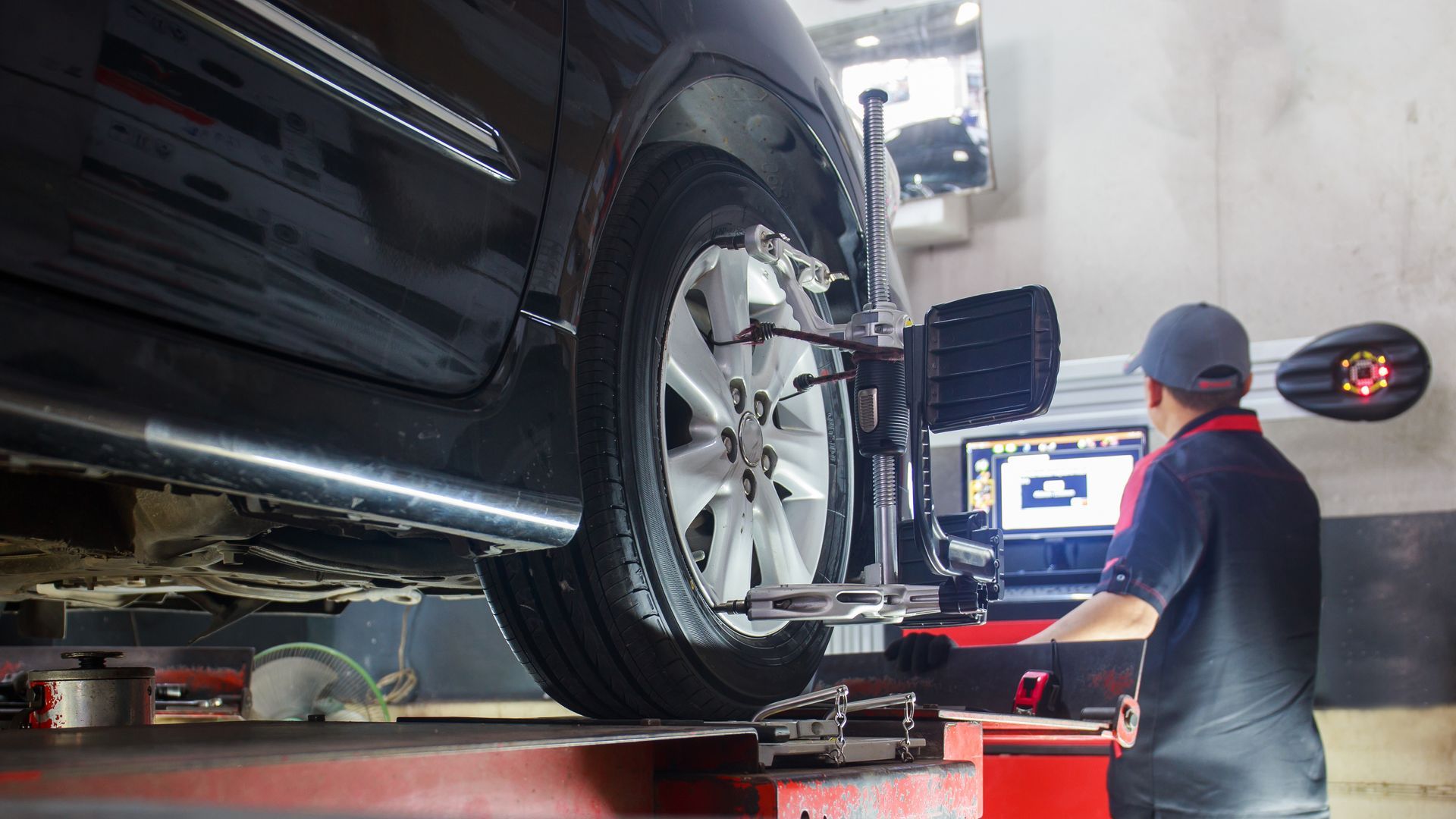
Balancing addresses rotating mass distribution. Alignment adjusts specified wheel angles so the tires meet the road as intended. A car that pulls or wears tires unevenly may need an alignment or suspension inspection, while a speed-related vibration can call for checking balance and other rotating components.
New tires don't automatically solve either condition. The vehicle's wear pattern, symptoms, and measurements guide the appropriate service. A bent wheel or damaged tire should also be identified before alignment is presented as the cure for vibration. Each service has a specific purpose within the full inspection.
Wheel Weights Need Secure Installation And Rechecking
A weight that loosens or falls off changes the correction. Adhesive weights need a suitable clean mounting surface, and clip-on weights must fit the wheel correctly. If vibration develops after a pothole strike or wheel service, check the assembly for damage and missing weights.
Leave the weights in place. If their appearance bothers you, discuss suitable placement when the wheels are serviced, rather than pulling them off. A new tire or another change to the assembly may need a fresh balance, because the old weights were selected for the combination that was fitted before.
Get Tire Balancing Service In Dieppe, NB
JP's Garage in Dieppe, NB, can check new tire installations, wheel balance, and vibrations that appear at road speed. We can explain what the measurements show and whether balancing, a mounting correction, or inspection of another component is appropriate for your vehicle.
Contact us to schedule tire balancing or an inspection of a persistent wheel vibration.